
Contents
More on Red Light
MitoPOD Review: Coverage, Sessions, and Who It Suits
A close look at the MitoPOD full body red light wrap: how its 660, 810, and 830 nm LEDs work against the skin, what a session is like, how often to use it, what the research does and does not say, how it compares with panels and pods, and who should choose something else.
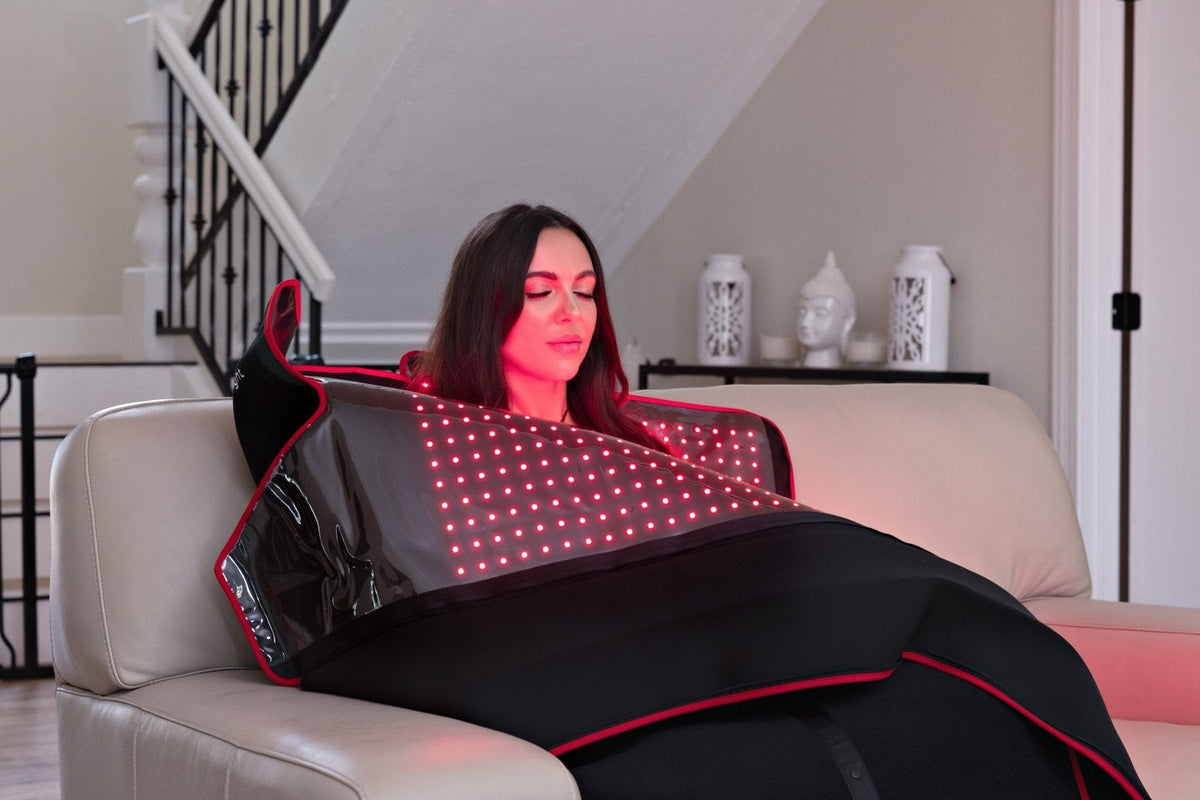
The MitoPOD is a flexible, full body red light wrap: a 62 by 54 inch sheet of neoprene lined with 2,320 red and near infrared LEDs. You lie in it, let the timer run, then fold it flat and put it away. This review covers how it works, what a session is like, how often to use it, what the research says, how it compares with our panels and pods, and who should choose something else.
The MitoPOD at a glance
| Spec | MitoPOD |
|---|---|
| Type | Flexible full body wrap, neoprene |
| Wavelengths | 660 nm red, 810 and 830 nm near infrared |
| Light blend | About 33% red, 67% near infrared |
| LEDs | 2,320 diodes with 3 chips each (6,960 chips) |
| Irradiance | 30 mW/cm² at the surface (1.8 J/cm² per minute) |
| Size and weight | 62 × 54 in unfolded, 62 × 24 in folded, 15 lb |
| Power | 97 W, 100 to 240 V |
| Controls | Brightness 1 to 100%, timer 1 to 20 minutes |
| EMF and flicker | 0 to about 0.5 mG above ambient at the surface; flicker eliminated LED driver |
| Certifications | FDA Class II registered, IEC 60601 certified |
| Warranty | 1-year warranty |
How the MitoPOD works
Red and near infrared light are absorbed inside your cells; the leading explanation is that the mitochondria take up that light and it supports normal energy production. This is called photobiomodulation. Red light at 660 nm acts mostly near the surface of the skin, while near infrared at 810 and 830 nm travels further into tissue. The MitoPOD weights its mix about two thirds toward near infrared, and every diode holds all three chips, so the blend is even across the wrap.
The other difference is distance. A panel's output falls as you step back, which is why panel figures are quoted at 6 inches. The MitoPOD rests on your skin, so its 30 mW/cm² is measured where the light meets you: 1.8 J/cm² per minute at full brightness, or 18 J/cm² in 10 minutes. Our guide to reading red light specs explains irradiance and dose.
What a session is like
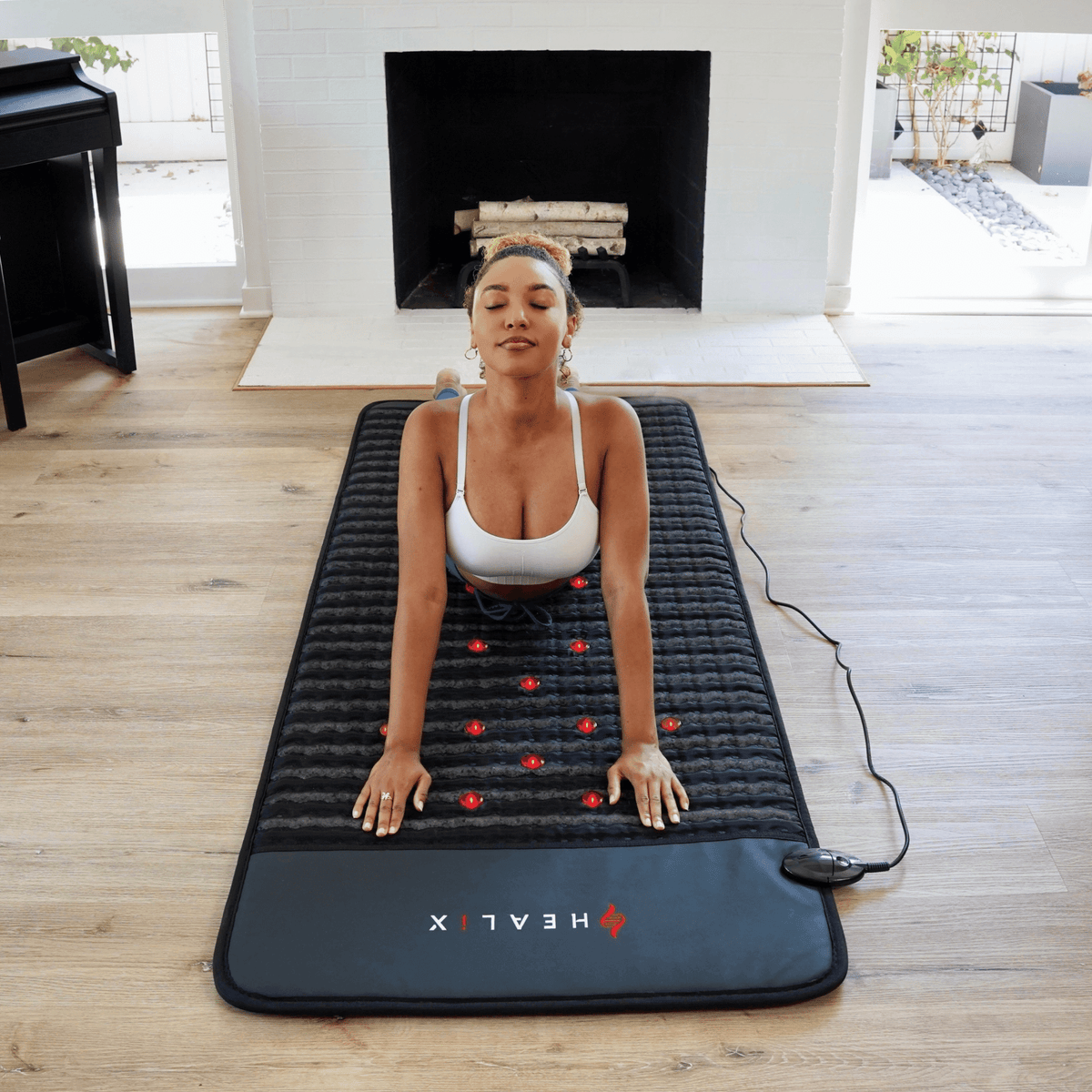
Unfold the wrap on a bed, a couch, or the floor near an outlet. Lie in it with bare skin against the LEDs, since clothing blocks most of the light, fold the sides over, set the brightness and timer, and rest. It runs on two power supplies, so plan for two cords. A wrap holds more warmth than an open panel, so expect a session to feel cozy.
One note on fit: the wrap is 62 inches long, so if you are taller than about 5 feet 2 inches, part of you sits outside it in any one position. Shift once partway through if you want light on your feet too. Afterward it folds to 62 by 24 inches and fits the included travel bag.
How often to use it
Most people use the MitoPOD 4 to 7 times a week. The brand suggests 10 to 20 minute sessions, starting at a lower brightness and building up. Consistency matters more than session length. Our guide to red light therapy at home covers routines, timing, and the most common mistakes.
What the research says
Photobiomodulation has a real and growing body of research, with the most work on skin appearance and exercise recovery. Most studies are small, use panels, lasers, or targeted devices, and test different wavelengths and doses, so results do not transfer neatly from one device to another; few test full body wraps directly. In short, the MitoPOD delivers wavelengths the research works with, in a format that is easy to use often, and it is a wellness device, not a treatment. It does not diagnose, treat, or prevent any condition. Our red light evidence guide covers the research in more detail. Kove does not provide medical advice; see the medical disclaimer.
Safety and comfort
The MitoPOD uses red and near infrared light, with no UV. Keep your eyes closed or wear protective eyewear during sessions. Check with a clinician first if you are pregnant, take light sensitizing medication, or have a medical condition in the area you plan to use it. Do not use it over implanted electronic devices; children should use it only with adult supervision. Keep it out of saunas and hot, humid rooms, which wear down the LEDs.
The MitoPOD is FDA Class II registered and IEC 60601 certified, an electrical safety standard used for medical electrical equipment; our FDA labels guide explains what each label means.
MitoPOD, a panel, or a pod?
A panel lights one side of you at a time while you stand or sit 6 to 18 inches away. The MitoMAX 2.0 ($749) and MitoMEGA 2.0 ($1,049) are full body panels rated above 70 and 74 mW/cm² at 6 inches, with a 2-year warranty; the MitoPRO+ series (from $369) links into an array and has a 3-year warranty. Panels are sturdier than any flexible device, which is why the MitoPOD's warranty is 1 year. Choose a panel for short standing sessions and long service life; our best red light panels guide sorts them by job.
A pod is the closest alternative: you slide in and lie down. The HEALiX Elevate Light Pod ($1,599.99) is collapsible, with 660 and 850 nm in equal parts at up to 149 mW/cm² at the surface, 25 lb, a 2-year warranty, and eyewear included. The BioLight Cocoon ($4,499) wraps 3,600 LEDs around front, back, and sides, with three light modes, five intensity levels, 17 lb, and a 3-year warranty. Brands measure output differently, so treat surface figures as a guide, not a ranking. The MitoPOD's case is its three wavelength mix, the lightest build at 15 lb, and a travel bag.
The wrap does not cover your face. For that, the MitoGLOW mask fits the face, and panel versus mask explains when a mask makes sense. List prices are as of October 2026; a promotion may be running, and the product page is the source of truth.
Who the MitoPOD suits, and who should skip it
- Suits you if you want full body light lying down, and a session that doubles as rest at the end of the day.
- Suits you if you have no wall for a panel, or want the same routine when you travel.
- Skip it if you prefer short standing sessions at a distance; the MitoMAX 2.0 suits that style.
- Skip it if you mostly care about one small zone; the MitoQUAD belt is the simpler, lighter pick.
- Skip it if getting many years out of the device matters most; a rigid panel such as the MitoPRO+ is built to last longer.
Can you pay with HSA or FSA?
The MitoPOD can qualify with a Letter of Medical Necessity, decided per order by an independent licensed provider through Truemed at checkout. Details on the HSA and FSA page, and the saving is worked through in is red light therapy HSA or FSA eligible.
Frequently asked questions
Is the MitoPOD worth it?
If you want full body light while lying down, in a device you can fold away or travel with, yes. For the most output per dollar and the longest service life, a rigid panel like the MitoMAX 2.0 is the better value.
Does the MitoPOD work?
It delivers 660, 810, and 830 nm light at 30 mW/cm² across a large area of skin. How much that helps depends on using it consistently. Red light research is promising but mostly small, and this is a wellness device, not a treatment.
How much does the MitoPOD cost?
The list price is $1,699 as of October 2026, with free US shipping, and it can qualify for HSA or FSA payment with a Letter of Medical Necessity through Truemed at checkout.
How long is a MitoPOD session?
The timer runs from 1 to 20 minutes. The brand suggests 10 to 20 minutes, starting at a lower brightness, and most people use it 4 to 7 times a week.
Can you travel with the MitoPOD?
Yes. It folds to 62 by 24 inches, weighs 15 pounds, comes with a travel bag, and runs on 100 to 240 V, so abroad it needs only a plug adapter.
What warranty does the MitoPOD have?
A 1-year warranty, plus 60 days from delivery to return it with a prepaid label from our team.
Is the MitoPOD safe?
It uses red and near infrared light with no UV and is IEC 60601 certified. Keep your eyes closed or wear eyewear, and check with a clinician first if you are pregnant or take light sensitizing medication.
The short version
The MitoPOD puts 6,960 red and near infrared LED chips directly on your skin in a wrap you lie in, then folds into a bag. It trades the output and durability of a rigid panel for comfort, coverage, and portability, and suits anyone who wants a lying down, full body routine without giving up a wall. See it on the MitoPOD page; it ships free in the US with the Price Beat guarantee, and our team can help you choose between the wrap, a pod, and a panel.