
Contents
More on Brain
NeuroVIZR Review: Sessions, Price, and Who It Suits
A close look at the NeuroVIZR Original: how eyes closed light and sound works, what a session is like, how often to use it, what the research does and does not say, how it compares with the Rouge and NV Lite on price, and who should choose something else.

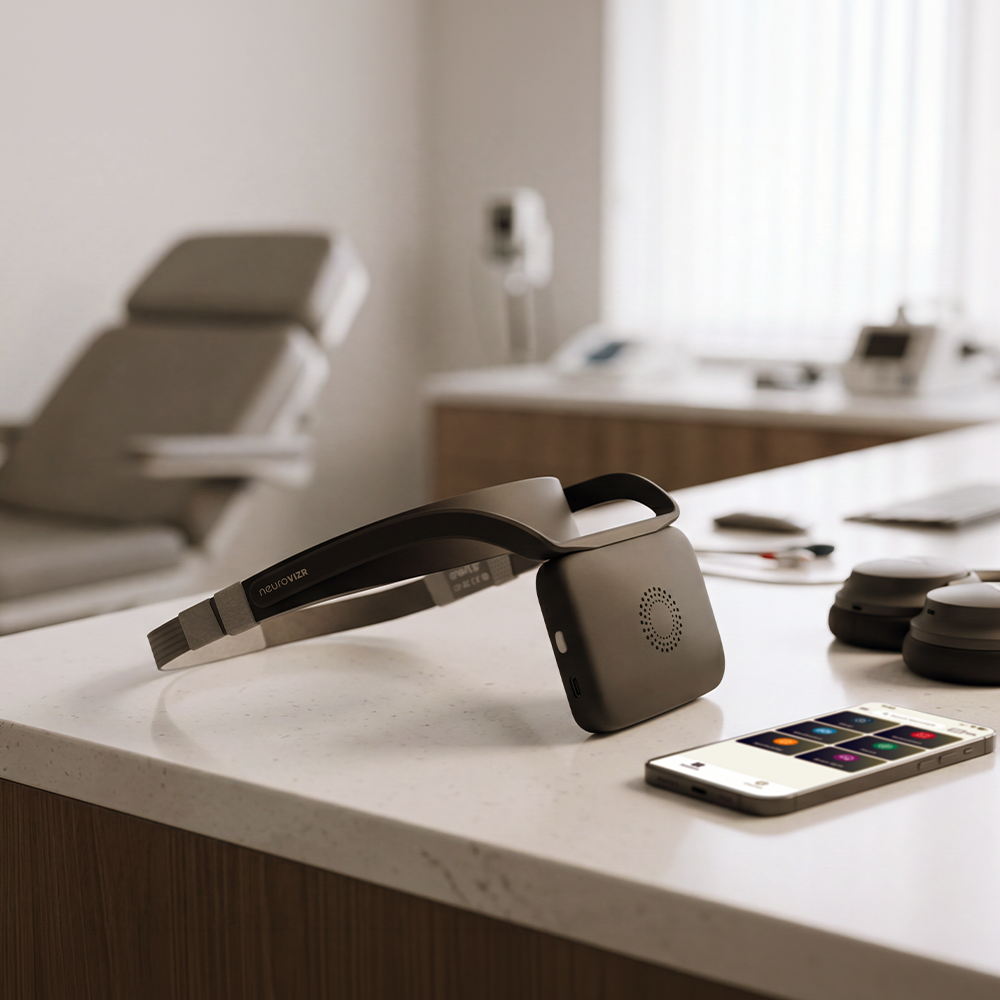
The NeuroVIZR Original is a small light and sound device that sits on a headband and runs with your eyes closed. Nine white LEDs play choreographed patterns through your eyelids while a matched soundscape plays from the free app, for a session of about 11 minutes. At Kove it lists at $599 in Ivory White or Space Grey, with 72 guided sessions included and no subscription. This review covers how it works, what a session is like, what the research says, how it compares with the Rouge and the NV Lite on price, and who should choose something else.
The NeuroVIZR Original at a glance
| Spec | NeuroVIZR Original |
|---|---|
| Type | Handheld light and sound device on a headband, used with eyes closed |
| Light | 9 white LEDs (4000K) |
| Stimulation | 40 Hz light and sound, with binaural beats and isochronic tones |
| Sessions | 72 guided sessions of about 11 minutes, plus 3 neuro-dosing courses |
| App | Free NeuroVIZR app for iOS 15+ and Android 10+, no subscription; more content is an optional in-app upgrade |
| Battery | Rechargeable LiFePO4, 800 mAh, about 3 to 4 hours to charge over USB-C |
| Weight | 110 g light unit, 195 g with headgear |
| Colors | Ivory White or Space Grey |
| In the box | Light unit, magnetic adjustable headgear, app access |
| Warranty | 1-year limited warranty (2 years in the EU) |
| Suitable for | Adults 18 and over |
How NeuroVIZR works
Brain activity runs in rhythms that tend to fall into step with a steady outside rhythm, such as a pulsing light or tone. This is called brainwave entrainment, and NeuroVIZR is built on it. The light unit sits a few centimeters in front of your closed eyes, and your eyelids diffuse its pulsing LEDs into shifting fields of color and shape. At the same time, the app plays a soundscape with binaural beats and isochronic tones inside it, so two senses receive the same rhythm at once. The published stimulation spec is 40 Hz light and sound.
Unlike a classic entrainment device that holds one rate throughout, NeuroVIZR sessions are choreographed: each moves through patterns and tempos like a piece of music, so it stays novel. The library is sorted by the state you want: sleep, relaxation, meditation, elevation, and focus. Our light and sound guide covers the category in more depth.
What a session is like
Charge the Original over USB-C and pair it with the app over Bluetooth once. After that, sit or lie back, put on the headband, choose a session on your phone, close your eyes, and let it run. Headphones help, because binaural beats rely on a slightly different tone reaching each ear. People often describe the first minutes as busy, the middle as absorbing, and the end as a distinct state, calm, drowsy, or alert, depending on the session.
How often to use it
NeuroVIZR's own guidance is 3 to 5 sessions a week, one at a time, which is under an hour a week. Pick by the state you want: focus or elevation in the morning, relaxation or sleep in the evening. Short and regular beats long and occasional.
What the research says
The basic effect is well documented: rhythmic light and sound pull the brain's electrical rhythms toward their rate while they play, and 40 Hz stimulation is an active area of university research. What lasts after a session is less settled. Most studies are small and short, use lab equipment instead of consumer devices, and show wide variation between people. In short, NeuroVIZR delivers a real effect and an experience most people feel right away, and it is a wellness device, not a treatment. It does not diagnose, treat, or prevent any condition. Kove does not provide medical advice; see the medical disclaimer.
Safety and comfort
Keep your eyes closed while the light plays, and use it seated or settled somewhere comfortable. NeuroVIZR is for adults 18 and over, and it is not suitable for anyone with epilepsy or a history of seizures. Anyone with light sensitivity should check with a medical professional first. Never run a session while driving.
Original, Rouge, or NV Lite?
Kove sells three NeuroVIZR models. All three use the same free app and the same eyes closed format; they differ in light, power, and how many sessions come included.
| Model | List price | Light | Power | Sessions included |
|---|---|---|---|---|
| NeuroVIZR NV Lite | $299 | 9 white LEDs (4000K) | Power cable, no battery | 6 (the Core collection) |
| NeuroVIZR Original | $599 | 9 white LEDs (4000K) | Rechargeable, USB-C | 72, plus 3 neuro-dosing courses |
| NeuroVIZR Rouge | $869 | 670 nm deep red LEDs | Rechargeable | 243, including 30 for the red light, plus 16 neuro-dosing courses |
List prices are as of October 2026; a promotion may be running, and the product page is the source of truth.
The NV Lite ($299) uses the same light unit as the Original, so a session feels the same, but it runs from a power cable and comes with six sessions. It is the cheapest way to find out whether light and sound works for you, if your sessions would happen beside the bed or at a desk anyway.
The Original ($599) adds a rechargeable battery, so it goes in a bag, and 72 sessions across all five states. For most people it is the one to start with.
The Rouge ($869) swaps the white LEDs for 670 nm deep red light, a warmer, softer glow built for unwinding. It includes the full library with nothing to upgrade, comes with a case, and its Ivory White body with rose gold detailing makes it a natural gift.
NeuroVIZR or Mendi?
They do different jobs. NeuroVIZR is passive: eyes closed, you sit back while a programmed session plays. The Mendi Headset is active: eyes open, it reads blood flow in the front of your brain and you lift a ball on screen by holding your focus. Mendi has no flashing light. Many people use an active practice by day and a passive one in the evening. Our Mendi Headset review covers it in detail, the meditation devices guide compares the formats, and the Brain & Light collection shows every option side by side.
Who NeuroVIZR suits, and who should skip it
- Suits you if sitting still with your own thoughts is the hard part, and you want a session that does the settling for you.
- Suits you if your day only has ten spare minutes at a time; an 11 minute session fits the gaps.
- Suits you if you want an eyes closed session to replace scrolling in the last hour before bed.
- Skip it if flashing light is not an option for you; the Mendi Headset has none.
- Skip it if you want a score to track; NeuroVIZR gives you an experience, not a measurement.
Can you pay with HSA or FSA?
All three NeuroVIZR models can qualify with a Letter of Medical Necessity, decided per order by an independent licensed provider through Truemed at checkout. Details on the HSA and FSA page.
Frequently asked questions
Is NeuroVIZR worth it?
If you want a short, eyes closed routine you will use a few times a week, yes: 72 sessions, a rechargeable unit, and no subscription. To test the idea first, the NV Lite uses the same light unit for $299. And you have 60 days from delivery to send it back.
How much does NeuroVIZR cost?
At Kove, the NV Lite lists at $299, the Original at $599 in either color, and the Rouge at $869, with no subscription needed for the included sessions.
Does NeuroVIZR work?
It delivers rhythmic light and sound that the brain measurably follows during a session, and most people feel a clear change in state. How much lasts beyond the session varies and is still being studied. It is a wellness device, not a treatment.
Does NeuroVIZR need a subscription?
No. The app is free on iOS and Android, and the included sessions need no subscription. More content is an optional in-app upgrade on the Original and the NV Lite.
How long is a NeuroVIZR session?
About 11 minutes on the Original. NeuroVIZR suggests 3 to 5 sessions a week, one at a time.
What is the difference between the NeuroVIZR Original and the Rouge?
The Original uses 9 white LEDs and includes 72 sessions; the Rouge uses 670 nm deep red LEDs, is made for unwinding, includes 243 sessions, and comes with a case.
What warranty does NeuroVIZR come with?
A 1-year limited warranty (2 years in the EU) on all three models.
Is NeuroVIZR safe?
NeuroVIZR is for adults 18 and over, and it is not suitable for anyone with epilepsy or a history of seizures. Anyone with light sensitivity should check with a medical professional first.
The short version
The NeuroVIZR Original turns 11 minutes with your eyes closed into a guided light and sound session, with 72 sessions included, a rechargeable 110 g unit, and no subscription. Choose the NV Lite to test the idea for less, or the Rouge for deep red light and the full library. See it on the NeuroVIZR Original page; it ships free in the US with the Price Beat guarantee, and our team can help you choose between the three.