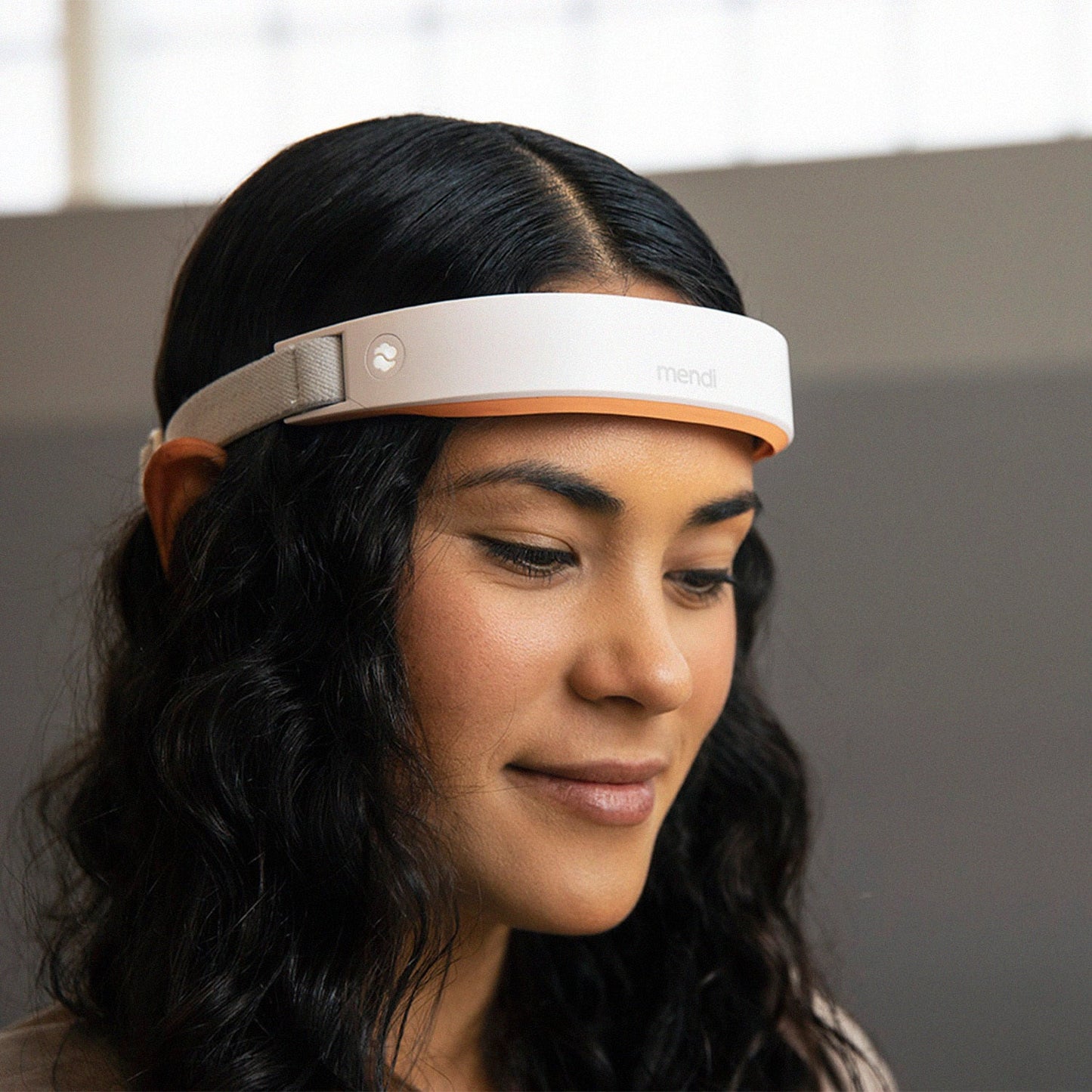
The Mendi Headset
- Watch your focus in real time as you guide a ball up the screen
- Practice focus and calm at home in just a few minutes a day
- Free app for iOS and Android, with no subscription to keep
- Lightweight headband that charges over USB-C between sessions
You can't train what you can't see. Why that matters
Most focus advice is abstract: sit still, concentrate, try harder. Mendi makes the target visible. An optical sensor on your forehead reads blood flow in your prefrontal cortex, the region tied to focus and planning, and turns it into a ball you move on screen. When your attention holds, the ball rises; when it drifts, it settles. That live feedback loop is the point: it gives an otherwise invisible skill something you can practice against, a few minutes at a time.
Neurofeedback is a training exercise; it does not diagnose, treat, or prevent any medical condition.
In stock. Ships free within the US in 1 to 2 business days
Sold out, more on the way
We will tell you the moment it lands.
One email about this device. Nothing else.
Please enter a valid email address.
We use this only to tell you this device is back. No newsletter unless you ask.
You are on the list.
We will email you the day it is back in stock.
Cannot wait? Talk to a real person at support@kovelongevity.com.
Not sure it fits your stack? Take the two minute quiz and we will map a starting point around you.
Recommended pairing
The MIP sends 810nm near infrared through the nasal channel toward the underside of the brain, close to the prefrontal cortex, in 25-minute sessions. Mendi reads blood flow in that same prefrontal region and turns your focus into a game, so light and active training reach one area by two routes.

The Mendi Headset
$261.75

Vielight MIP: Multimodal Intranasal Photobiomodulation Device
$349.00
Description
- A headband reads brain-activity signals and turns them into a simple, real-time app game
- Short guided sessions in the free Mendi app for iOS and Android, with no subscription
- A guided way to practice focus and calm at home, a few minutes a day
- In the box: the Mendi headband plus a USB-C charging cable
Mendi makes brain training something you can watch happen. You wear the headband, and as you hold your focus a ball rises on the screen, turning a few quiet minutes into a repeatable mental exercise you can return to daily.
Is this right for you?
You'll get the most from it if
- You like feedback you can see: the app turns focus into something you can watch session to session.
- You want an active, screen-based practice rather than a passive one you sit back for.
- You have a few spare minutes a day; sessions are short by design and reward consistency.
- You want something the whole household can use; Mendi is non-invasive and listed for ages five and up.
Maybe look elsewhere if
- You prefer a hands-off, eyes-closed experience; a light and sound device like NeuroVIZR may suit you better.
- You want clinical treatment for a diagnosed condition; Mendi is a consumer brain-training tool, not a medical device.
- You would rather not use a phone; every session runs through the Mendi app.
Specifications
| Format | Forehead-worn neurofeedback headband, used with the free app |
|---|---|
| Technology | fNIRS optical sensing - reads blood flow and oxygenation in the prefrontal cortex |
| Feedback | Real-time: your focus moves a ball in the app |
| Motion sensors | Accelerometer and gyroscope |
| App | Free Mendi app (iOS and Android), no subscription |
| Connectivity | Bluetooth to your phone |
| Battery | Up to 5 hours, about 60 sessions per charge |
| Charging | USB-C, cable included |
| Fit | One size fits all, lightweight, sits on the forehead |
| Session length | About 5 to 15 minutes, best in dim lighting |
| In the box | Mendi headband, USB-C charging cable, free app access |
| Suitable for | Ages 5 and up; non-invasive, no electrical stimulation |
| Made in | Sweden |
How to use
- Charge & pairCharge over USB-C, then connect to the free Mendi app by Bluetooth
- Put it onRest the headband on your forehead and choose a session in the app
- Play the gameFocus to move the ball upward; the app responds to your brain activity in real time
- FrequencyStart with three 5-minute sessions a week, then build to 4-5 sessions of 10-15 minutes
- Good to knowUse in dim lighting for the cleanest signal; non-invasive, with no electrical stimulation
Shipping & delivery
Free shipping within the United States on every order. Most orders ship within a few business days, and you will receive tracking as soon as your order is on its way. Larger items may ship freight with a delivery appointment.
Warranty & returns
1-year limited warranty.
You have 30 days from delivery to start a return. Items need to come back unopened and unused, in the original packaging. Contact us first and we will authorize the return and send you the correct return address; returns sent without authorization can end up at the wrong warehouse. Return shipping is the customer's responsibility, and outright returns carry a restocking fee, typically around 20%, up to 25% on large freight items. Exchanging for something else instead? We can often help cover part of the cost.
Cancellations are free any time before your order ships. If your delivery arrives damaged, send photos of the damage, the box and the SKU to support within 24 hours and we will handle the claim for you.
See our Return Policy for full details.
Why it earns a place in the stack. Most brain tools ask you to trust an invisible process. Mendi shows it to you: the headband reads your brain's signals and turns focus into a ball you move on screen. A few minutes a day builds a simple, repeatable practice, with no clinic visit and no subscription.
Choose options
Frequently Asked Questions
What exactly comes in the box?
How does a Mendi session work?
How often should I use it, and for how long?
Do I need my phone, and are there ongoing fees?
Is it safe, and who can use it?
How is Mendi different from a light and sound device like NeuroVIZR?
From the Journal
How to Build Your First Longevity Stack: A Beginner's Framework
Red Light Therapy: What the Evidence Actually Says
Cold Plunge Benefits: A Practical Guide to Cold Exposure
Infrared Saunas and Heat Therapy: What to Know
PEMF Therapy: How It Works and What the Evidence Shows
Light and Sound Brain Wellness: How It Works and What the Science Says
Biological Age, Explained: What It Is and How Testing Works
Build Your Own Stack
Not sure where to start? Take our Build Your Own Stack quiz. Answer a few questions and we'll map a starting point built around you, in about two minutes.
Send us your goals
We'll reply with a stack matched to your goals.
Our approach
Every product earns its place.
No single thing changes your biology on its own. What matters is the system, and whether each piece earns its place. Here is how a device makes it into Kove.
01
Start with the evidence
Where there is research behind how something works, we read it. We look at the real mechanism a device relies on, like the wavelength, the frequency, or the dose, and whether the evidence holds up. Substance comes before marketing, and we are honest about how strong that evidence is.
02
Separate mechanism from marketing
A claim is not a mechanism. We check a device's real output against its stated one: does the panel emit the 660 and 850nm it advertises, at the irradiance that makes those numbers matter? The marketing language gets set aside. The measurable spec is what we judge.
03
Verify build and dose
Even a good idea does nothing if the hardware is weak. We confirm the output is consistent, the dose is usable in a real daily routine, and the build holds up over years, because a device only helps if it lasts as long as the habit.
04
Held to one standard
What clears every step earns its place in the system, held to the same standard as everything else. That consistency is what you can count on.