

Contents
More on Red Light
Red Light Panel vs Mask: Which Should You Buy?
Panels cover more area at higher output; masks win on convenience and consistency for the face. The honest decision framework, with the numbers.
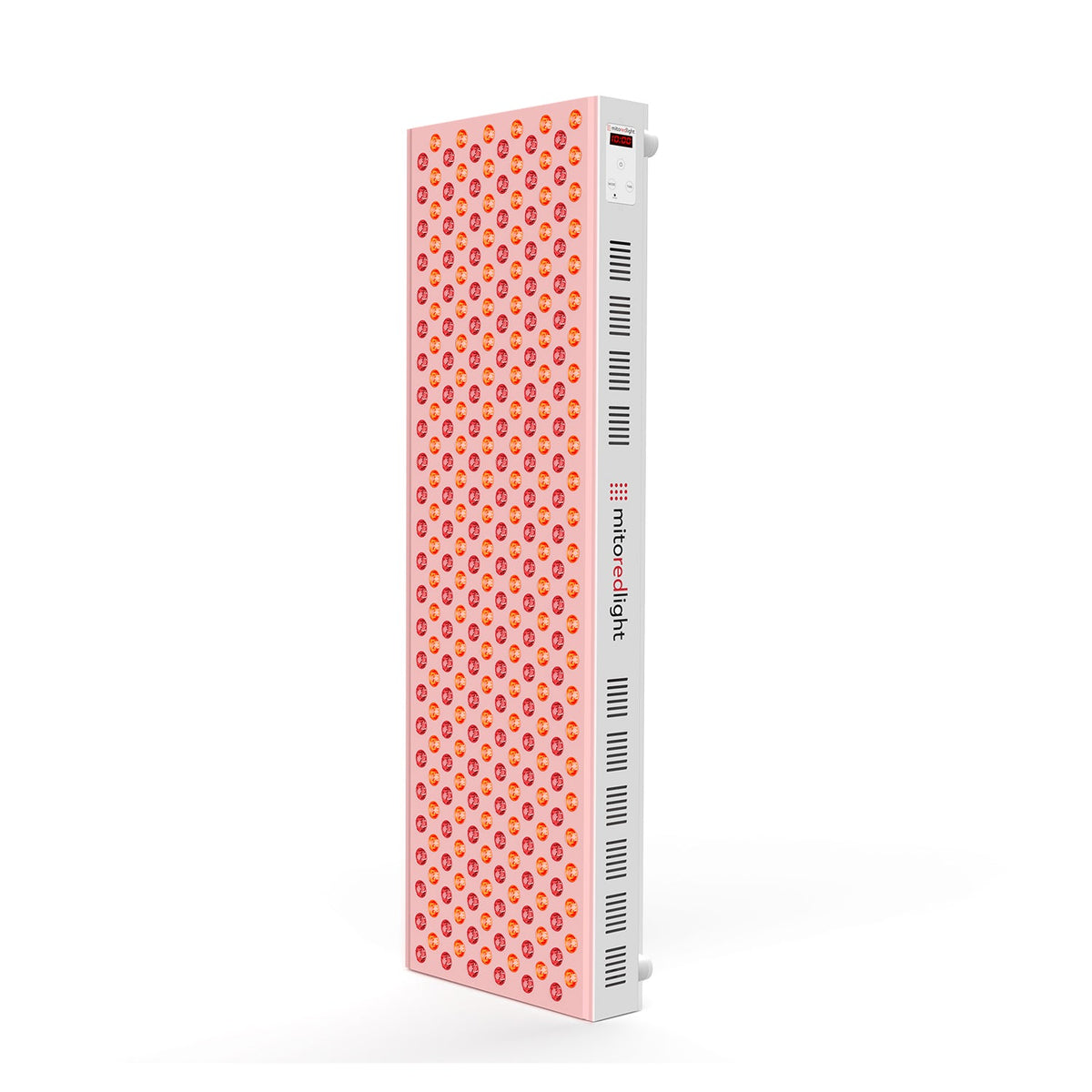
A red light panel covers more area at higher measured output and serves the whole body. A mask treats only the face, at gentler output, but wins the one contest that decides results: it gets used, hands free, while you do something else. Face-only goals favor the mask; anything beyond the face favors a panel; serious skin-plus-recovery routines eventually own both.
This is the most common either-or question in red light, and most answers dodge the trade-offs. Here they are with numbers. For the underlying science and specs, the red light therapy guide is the deep version.
The core trade: output and coverage vs convenience
Panels are the stronger instruments on paper. The MitoPRO+ series measures over 60 to 68 mW/cm² at six inches, and full-body options like the MitoMAX 2.0 exceed 70. The MitoGLOW mask publishes up to 25 mW/cm², but worn directly on the face, where distance is zero and cannot drift. That difference matters more than it looks: a panel's number is only true at six inches, and real people slide backward. A mask's dose is locked in by design, sessions run 5 to 10 minutes hands free, and it needs no wall space, no positioning, no discipline about distance.
Side by side
Prices as of September 2026; the product page is the source of truth.
| Mask (MitoGLOW) | Panel (MitoPRO+ to MitoMEGA) | |
|---|---|---|
| Coverage | Face only | Any body area; full body on larger panels |
| Published output | Up to 25 mW/cm², worn at zero distance | 60 to 74 mW/cm² at 6 inches, lab measured |
| Session | 5 to 10 minutes, hands free, mobile | 5 to 15 minutes per area, seated at fixed distance |
| Eye protection | Built-in blackout shield | Goggles, included with most panels |
| Regulatory status | FDA 510(k) cleared | FDA Class II registered, ETL listed |
| Space | A drawer | Wall, stand, or door mount |
| Price | $499 | $369 to $1,049 |
Buy the mask if...
- Your goal is skin, and specifically facial skin. That is what the 1,064-LED array and the five modes are built for, and the format guarantees the consistency skin results require over 8 to 12 weeks.
- Sessions have to survive a busy routine. A mask runs while you answer email; a panel asks you to sit still at six inches.
- The 510(k) clearance matters to you for a device worn over the eyes. The MitoGLOW carries it; most panels are registered rather than cleared.
Buy a panel if...
- Anything beyond the face is on the list: shoulders, back, legs, post-training recovery. A mask cannot follow you there.
- You want one device for multiple people or multiple uses. Sessions are minutes long, so a household shares a panel easily.
- You want the option to grow. The modular MitoPRO+ starts at $369 for targeted work and links into a full-body array later, which is the cheaper road to full coverage than buying big on day one.
The both answer
The pairing people settle into is a mask for the daily facial slot plus a panel for body work a few times a week, because the two jobs genuinely differ. If that is the destination, the order still matters: buy the device for your primary goal first, prove the habit for two months, then add the second. The stack quiz sorts the starting point in about two minutes, and both formats commonly qualify for HSA and FSA dollars.
Frequently asked questions
Is a red light mask as effective as a panel?
For the face, a well-built mask delivers research-range doses because it is worn at zero distance and used consistently. For anything beyond the face, a panel is the only real option. Effectiveness follows the match between device and goal, not the bigger spec sheet.
Can you use a panel on your face instead of a mask?
Yes, with goggles and at the measured distance. What you give up is the hands-free convenience that makes daily facial sessions actually happen, which is the mask's real advantage.
Why is the mask's irradiance lower than a panel's?
By design. Worn at zero distance, a mask needs far less raw output to deliver skin-range doses, and facial skin sessions target the 3 to 10 J/cm² range that gentler output reaches in minutes. Higher is not the goal; the right dose is.
Which is better for wrinkles and skin texture?
Skin research uses exactly the wavelengths and doses both formats deliver to the face. The honest answer is that consistency over 8 to 12 weeks decides it, and the mask's format makes consistency easier for most people.
What about red light beds and pods?
A third category for whole-body coverage lying down, covered in the format table of the main guide. They solve coverage completely at a different price and footprint.
The short version
Face only: mask. Body: panel. Both goals, eventually both, primary goal first. Compare every format with published output numbers in the red light collection, free US shipping and the Price Beat guarantee included.


