
Contents
More on Red Light
Irradiance, Wavelength, Dose: Reading Red Light Specs
The three numbers on a red light spec sheet that matter, irradiance, wavelength and dose, how to tell an honest irradiance figure from an inflated one, and what LED counts, watts and pulsing ranges really tell you.
A red light therapy spec sheet has three numbers that matter and a dozen that are there to impress you. The three are irradiance, which is how much light lands on you; wavelength, which is what kind of light; and dose, which is irradiance multiplied by time and is the only number your tissue actually experiences. Everything else on the sheet, LED counts, chip counts, watts, joules per session, beam angles, pulsing ranges, is either a way of restating those three or a way of avoiding them. This guide reads the sheet line by line, in the order the numbers matter.
Irradiance: the number that matters most
Irradiance is optical power arriving per unit of area, written in milliwatts per square centimeter, mW/cm². It is the rate at which a device delivers light to your skin at a stated distance. Two conditions make the number meaningful, and a spec that leaves either out is not telling you much.
The first is distance. Irradiance falls quickly as you move away from a panel, so a figure at the surface and a figure at six inches describe different sessions. Panels are usually quoted at six inches; wraps and pods at the surface, because that is where they sit. The second is the instrument. A solar power meter, the handheld tool many brands use, responds to a broad band of light and overstates red and near infrared output by two to three times. A lab spectroradiometer measures the actual spectrum and gives a lower, honest figure. Mito Red Light publishes both, which makes the gap visible: the MitoPRO Mobile reads 40 mW/cm² on a spectroradiometer at three inches and 100 on a solar meter; the MitoMIND reads 14 and 28. Whenever two devices are compared, compare the same instrument at the same distance or do not compare at all.
For orientation: full-size home panels measured properly land around 60 to 75 mW/cm² at six inches. Wraps that sit on the skin run lower, 18 to 30 mW/cm² at the surface, and make it up with time and contact. Neither is better; they are different formats.
Wavelength: what kind of light
Wavelength is measured in nanometers and decides how deep the light reaches and what absorbs it. Red, 620 to 700 nm, is absorbed within the first few millimeters and is the range used for skin. Near infrared, roughly 800 to 900 nm, is invisible and penetrates deeper, into muscle and joint tissue. The evidence base clusters around a few specific values: 630 and 660 nm in red, 810, 830, and 850 nm in near infrared. A device that lists one of each is covering the two jobs. A device listing five or seven wavelengths is not automatically better; it is offering finer choices within the same two bands, and some of those values matter mostly on paper.
Watch for how the wavelengths are mixed. "Red, near infrared, or both" modes let you pick per session. A fixed blend such as "33 percent red, 67 percent near infrared" tells you the balance you will always get. Equal parts across four wavelengths, as on the MitoPRO+ series, spreads the output evenly. None of these is wrong, but the mode you cannot switch off is the mode you will use.
Dose: the number your tissue sees
Dose is energy delivered per area, in joules per square centimeter, J/cm². It is irradiance multiplied by time in seconds, divided by 1,000. A panel delivering 60 mW/cm² for 10 minutes gives 60 × 600 ÷ 1,000, or 36 J/cm². The same panel at 12 inches might deliver 25 mW/cm², which would take 24 minutes to reach the same dose. Some manufacturers do the arithmetic for you: the MitoPOD wrap's 30 mW/cm² is published alongside 1.8 J/cm² per minute, which is the same figure expressed per minute.
The published research on skin and tissue mostly lands in the tens of joules per square centimeter per session, and more is not better past that range; the response curve flattens and can reverse. Practical session lengths, distances, and how to work backwards from a target dose are in red light therapy at home. This page's job is to make sure the irradiance you plug into that arithmetic is a real one.
Joules per session: a dose figure in disguise
Some panels advertise total energy delivered, such as 68,040 joules in a 10 minute session for the MitoMAX 2.0 or 106,560 for the MitoMEGA 2.0. These come from independent testing and are honest, but they are whole-panel totals: irradiance multiplied by time multiplied by the LED field's area. A bigger panel always posts a bigger number because it is a bigger panel. They are useful for confirming that a device's irradiance claim holds up across its whole face, not for comparing a large panel to a small one.
LED counts, chip counts, and watts
LED count mostly describes size. Within a series the irradiance is similar and the count scales with the panel: 60, 200, and 300 LEDs on the MitoPRO+ 300+, 1000+, and 1500+ deliver 60 to 68 mW/cm² while covering progressively more of you. Chip counts inflate that further: a "TriChip" diode carries three emitters, so 2,320 diodes becomes 6,960 chips on the same wrap. Dual-chip diodes, common on BioLight panels, can fire red, near infrared, or both from one lens. Read these as what they are, a description of how the light is built, and go back to irradiance for how much of it arrives.
Watts on a spec sheet are electrical draw, not light output. A 450 W panel consumes 450 W from the wall; a fraction of that leaves as red and near infrared light and the rest is heat and electronics. Power draw is useful for two things: it tells you what the panel costs to run, and it flags a claim that cannot be true, since optical output cannot exceed electrical input.
Beam angle and coverage
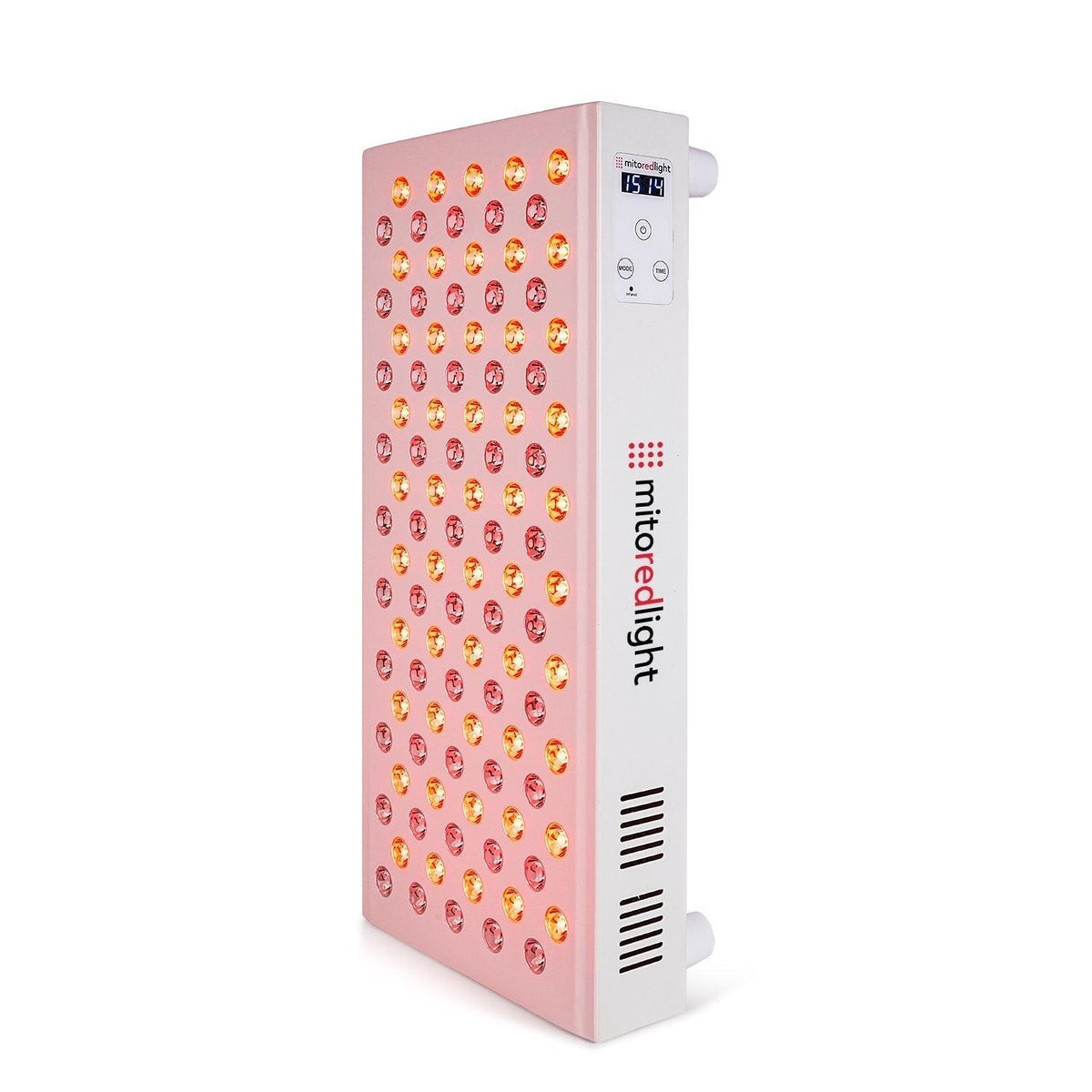
Beam angle is how wide each LED spreads its light. A 60 degree angle is common on panels: wide enough to blend into an even field at six inches, narrow enough that the light does not scatter uselessly to the sides. Narrower angles, 15 or 30 degrees, concentrate output and hold irradiance better at distance but light a smaller area; some panels mix angles for that reason. Coverage is simpler: the physical dimensions of the LED field, which set how much of you a session reaches at a given distance. A 36 by 12 inch panel covers a torso at six inches; a 10 by 12 inch panel covers a face or a knee.
Pulsing, flicker, and EMF
Pulsing switches the light on and off at a set frequency, quoted in hertz. Ranges like 0 to 10,000 Hz are a capability, not a benefit; pulsed light is an active research area without a settled home protocol. Treat it as a feature to experiment with rather than a reason to choose a device.
Flicker is unintended pulsing from the LED driver, usually at mains frequency. It is invisible at the rates involved but some people find flickering light fatiguing. A device that states "flicker-free" or publishes a measured figure such as 1.2 percent has addressed it.
EMF is the electromagnetic field from the electronics, quoted in milligauss or microtesla at a stated distance. Quality panels post figures near background at normal use distance, for example 0.5 to 1 mG close to the panel and background at six inches. It is a build-quality signal rather than a performance one.
Certifications: registered is not cleared
"FDA Class II registered" means the manufacturer is registered with the FDA and the device is listed; it is not a review of the device's claims. "FDA cleared" means a specific device went through the 510(k) process for a specific use. Among our products, the MitoGLOW mask is 510(k) cleared; most panels carry facility registration plus safety and electrical marks such as ETL, UL, CE, IEC 60601, and quality-system standards such as ISO 13485. The full distinction, and what each label lets a brand say, is in FDA-cleared red light therapy devices.
The spec sheet, in reading order
| Line | What it really tells you | Weight |
|---|---|---|
| Irradiance, with distance and instrument | How much light arrives; only comparable on the same instrument at the same distance | Decides the session |
| Wavelengths | Skin (630, 660 nm) versus deeper tissue (810 to 850 nm); whether you can choose per session | Decides the use |
| Dose per minute or per session | Irradiance times time; the number your tissue experiences | Decides the length |
| Panel dimensions | How much of you is covered at a given distance | Decides the format |
| Modes, brightness, timer | Whether you can run the session you want, including evening sessions | Convenience |
| LED and chip counts, watts, joules per session | Size and build, restated; never a substitute for irradiance | Context only |
| Flicker, EMF, certifications | Build quality and what the brand is allowed to claim | Trust |
| Pulsing range | A feature to experiment with, not evidence of benefit | Optional |
With the sheet decoded, the choosing happens in the Red Light collection, and the evidence the numbers are meant to serve is in what the research actually says.
Frequently asked questions
What is a good irradiance for red light therapy?
For a home panel, roughly 60 to 75 mW/cm² at six inches measured on a lab spectroradiometer. Wraps that sit on the skin run 18 to 30 mW/cm² at the surface and use longer contact sessions instead. Figures from a solar power meter should be roughly halved before comparing.
How is dose calculated?
Irradiance in mW/cm² multiplied by seconds, divided by 1,000, gives joules per square centimeter. Sixty mW/cm² for ten minutes is 36 J/cm².
Is 660 nm or 850 nm better?
Different depths. 660 nm red is absorbed in the skin; 850 nm near infrared reaches muscle and joint tissue. Most devices offer both, and the choice per session depends on what you are aiming at.
Does more LEDs mean more power?
More coverage, not more irradiance. Within a series, the irradiance stays similar and the count scales with panel size.
What is the difference between a spectroradiometer and a solar meter reading?
The spectroradiometer measures the actual spectrum and gives the honest figure; the solar meter responds to a broad band and reads two to three times higher. Where a brand publishes both, the lab figure is the one to use.
Do watts tell me how strong a panel is?
No. Watts are electrical draw. They tell you running cost and set a ceiling on plausible output, nothing more.
Does pulsing make red light therapy work better?
Unproven at home. It is an active research question with no settled protocol, so treat a pulsing range as an option rather than a reason to buy.
What does FDA registered mean on a red light device?
That the manufacturer is registered and the device is listed with the FDA. It is not a review of the device's claims; that is what 510(k) clearance is.
The short version
Read irradiance first, and only trust it with a distance and an instrument attached. Check for one red and one near infrared wavelength you can choose between. Turn irradiance into dose with the time you will actually spend. Treat LED counts, chips, watts, and joules per session as descriptions of size, and pulsing as a curiosity. Then choose by coverage and control. Everything in the Red Light collection publishes these numbers, ships free in the US, and carries the Price Beat guarantee.