
Contents
More on Heat
Infrared vs Traditional Sauna: Heat, Time, Comfort
How a hot room and an infrared panel heat a body differently, what a session costs in minutes and watts, what the evidence says about each, and how to choose the one you will use three times a week.
A traditional sauna heats the air to 170 to 200 degrees Fahrenheit and lets the air heat you. An infrared sauna heats you directly with infrared light at an air temperature of 100 to 170 degrees. The sweat is comparable; the experience, the time budget, the electrical demands, and the research behind each are not. This guide takes the comparison further than a table: how each one actually heats a body, what a session costs in minutes and watts, which one the evidence favors, and how to decide when the honest answer is "the one you will use three times a week".
How each one heats you
A traditional sauna is convective. A stove, electric or wood, heats rocks; the rocks heat the air; the air heats your skin, and ladling water onto the rocks adds a burst of humidity that makes the same temperature feel far hotter. The room has to reach temperature before you enter, which is why the stove runs for 30 to 60 minutes first. Inside, the air itself is the heat source, and breathing it is part of the experience.
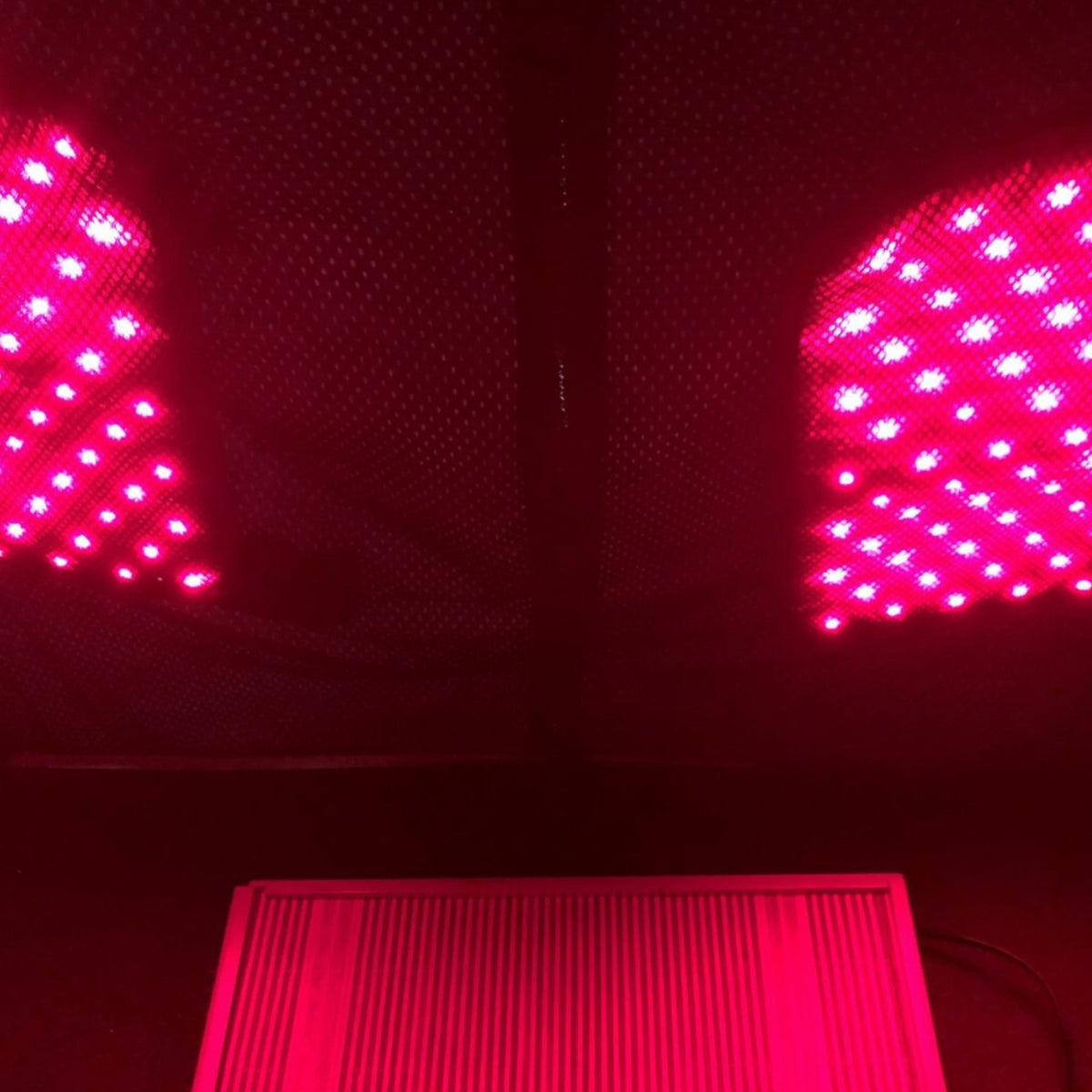
An infrared sauna is radiant. Panels or heating elements emit infrared light, mostly far infrared in the 5 to 13 micron range, sometimes with near and mid infrared as well. That light is absorbed by skin and the tissue just below it, so your body warms before the air does. A blanket or tent reaches working temperature in minutes, and the air around you stays mild enough to breathe easily, which is why infrared sessions run longer and feel gentler while still producing a full sweat.
Heat: what your body experiences
Both raise core temperature, push heart rate toward brisk-walk or light-jog levels, dilate blood vessels, and trigger sweating. The difference is the route. In a traditional sauna the heat load is intense and arrives from all sides; skin temperature climbs fast and the session is self-limiting, 10 to 20 minutes before most people step out. In an infrared session the load builds more gradually, sessions run 20 to 45 minutes, and people typically report a heavy sweat with less of the breathless, pressing quality of a hot room. Sweat volume is roughly comparable per session; it tracks heat load and hydration, not which technology produced it.
Time: the session budget
| Traditional | Infrared | |
|---|---|---|
| Preheat | 30 to 60 minutes | Minutes for a blanket, 10 to 15 for a tent |
| Session | 10 to 20 minutes, often in rounds | 20 to 45 minutes, one round |
| Air temperature | 170 to 200+ °F | 100 to 176 °F depending on format |
| Cool-down and cleanup | Shower; room vents on its own | Shower; wipe a blanket or air a tent |
| Wall-to-wall time | About an hour and a half | About 45 minutes to an hour |
Time is where infrared wins for most homes. A blanket that is warm in three minutes gets used on a Tuesday night; a room that needs 45 minutes of preheating gets used on Sunday. Since the research rewards frequency, three to five sessions a week, the format that fits a weekday is usually the format that delivers the benefit.
Comfort: air, humidity, and headroom
Traditional sauna is a sensory event: dry, then a wave of steam, wood, heat you feel in your nose. People who love it love exactly that, and for them infrared can feel like a warm nap by comparison. Infrared wins on breathability, on tolerance for people who find 190-degree air oppressive, and on head-out formats. A tent like the Thera360 Plus leaves your head outside, so you can read, breathe room air, and never feel enclosed; a blanket leaves your head on a pillow. Anyone with a history of feeling faint in hot rooms tends to do better with a head-out infrared format.
What the evidence says about each
The famous longevity data is traditional. Long-running Finnish cohort studies of frequent sauna bathers found associations between regular sessions and cardiovascular outcomes, and those studies were done in hot rooms, four or more times a week, with the frequency mattering more than session length. That research base is deeper than anything infrared has.
Infrared has its own line. Japanese researchers studied a specific far infrared protocol, a short session at around 140 degrees followed by a period of warmth under blankets, in clinical settings, and reported cardiovascular measures moving in the same direction. Smaller studies on infrared blankets and cabins report the expected acute effects: raised core temperature, heart rate, sweat, and reported relaxation. The honest summary is that both deliver the heat stress that the mechanism depends on; traditional sauna has the long observational record, infrared has younger and smaller evidence at lower air temperatures. Nothing here treats a condition, and the heat therapy guide covers the full evidence picture.
Cost, power, and space
A traditional sauna is a construction project: a room or an outdoor barrel, a stove of several kilowatts on a dedicated 240-volt circuit, ventilation, and a price that runs from a few thousand dollars for a kit to well beyond that installed. An infrared cabin is cheaper and still a piece of furniture with its own wiring. Infrared blankets and tents are appliances: the HEALiX blankets draw 600 W and the Thera360 Plus draws 900 W from an ordinary outlet, fold or pack away, and cost $499.99 and $1,428 respectively. The blanket versus cabin decision is its own guide; the point here is that infrared is the only version of regular heat most apartments can hold.
Near, mid, and far infrared
Infrared saunas are sold as far infrared or full spectrum. Far infrared, 5 to 13 microns, is absorbed at the skin and is what produces the sauna effect; it is the band in every infrared blanket and mat. Near infrared, around 800 to 1,000 nanometers, is the band used in red light therapy and penetrates deeper but contributes little heat. Mid infrared sits between. A full-spectrum tent such as the Thera360 Plus adds near and mid infrared panels and red light to the far infrared, which is a red light session and a sauna in the same sitting rather than a hotter sauna.
Infrared or traditional: the decision
- You have the space, the wiring, and a love of the hot room: traditional. The evidence is deepest and the ritual is the point.
- You want three sessions a week in an apartment or a spare corner: infrared. Blanket if you want to lie down and fold it away, tent if you want to sit up, read, and keep your head out.
- Hot air makes you faint or claustrophobic: infrared, head out.
- You want red light in the same session: a full-spectrum tent.
- You want warmth under you for an hour rather than a sweat: neither; that is an infrared mat.
Whichever you choose, the pairing with cold is the same: contrast therapy works with either heat source, and the safety rules do not change: hydrate, no alcohol around sessions, end early if lightheaded, and anyone pregnant or managing a heart condition talks to a clinician first. Kove does not provide medical advice; see the medical disclaimer.
Infrared formats at Kove
Specs as published by each manufacturer. Prices as of September 2026; the product page is the source of truth.
| Format | Heat | Session | Power | Price |
|---|---|---|---|---|
| HEALiX Sauna Blanket (velcro) | Far infrared 5 to 13 micron, 77 to 176 °F in 2° steps, zero-EMF | 20 to 60 min lying down | 600 W, standard outlet | $499.99 |
| HEALiX-Z Sauna Blanket (zipper) | Same heating, zipper closure | 20 to 60 min lying down | 600 W, standard outlet | $499.99 |
| Thera360 Plus tent | Full spectrum near, mid, far plus 2 red light panels, 100 to 170 °F in 5° steps, low-EMF | Up to 90 min seated, head out | 900 W, standard outlet | $1,428 |
Can you pay with HSA or FSA?
Saunas are among the categories that can qualify with a Letter of Medical Necessity, decided per order by an independent licensed provider through Truemed at checkout. Details on the HSA and FSA page.
Frequently asked questions
Is an infrared sauna as good as a traditional sauna?
Both deliver the heat stress the benefits depend on. Traditional sauna has the deeper research record; infrared runs at lower air temperatures with younger, smaller evidence, and is far easier to use several times a week at home. The better sauna is the one you actually use.
Which is hotter?
Traditional, by air temperature: 170 to 200 degrees or more against 100 to 176 for infrared formats. Your body reaches a comparable sweat in both because infrared heats you directly rather than through the air.
Does infrared take longer?
The session is longer, 20 to 45 minutes against 10 to 20, but the preheat is minutes instead of half an hour or more, so the total time is shorter.
Do you sweat as much in an infrared sauna?
Roughly, yes. Sweat tracks heat load and hydration. Infrared reaches it at a lower air temperature over a longer session.
Is infrared safer than traditional?
Gentler, not risk-free. Lower air temperature and head-out formats reduce faintness and breathing discomfort, but dehydration, alcohol, pregnancy, and heart conditions call for the same care in both.
What is the difference between far infrared and full spectrum?
Far infrared is the heating band, in every blanket and mat. Full spectrum adds near and mid infrared, which contribute little heat but bring the red light band into the same session.
Does a traditional sauna need special wiring?
Usually a dedicated 240-volt circuit for the stove. Infrared blankets and tents plug into a standard outlet at 600 to 900 W.
Which should a beginner buy?
An infrared blanket or tent, because it will be used. Move to a traditional sauna later if the habit sticks and the space exists.
The short version
Traditional sauna heats the air and has the deepest evidence; infrared heats you directly, runs cooler and longer, needs no wiring or room, and fits a weekday. The mechanism is shared, the frequency is what matters, and the format you will use three times a week is the right one. Every option in the sauna collection ships free in the US with the Price Beat guarantee.