
Contents
More from the Journal
VOCs at Home: What Carbon Filtration Actually Removes
The gases off-gassing from furniture, paint, and cleaning products pass straight through HEPA. What VOCs are, where they hide, and why carbon weight is the spec that matters.

Volatile organic compounds are gases released by ordinary household things: new furniture, paint, adhesives, cleaning products, printers, dry-cleaned clothes. They pass straight through HEPA filters, because HEPA captures particles and VOCs are not particles. Removing them from air takes activated carbon, and the working spec is carbon weight: a serious unit carries 16 to 26 pounds of it.
VOCs are the invisible half of indoor air. You can see dust in a sunbeam and smell smoke, but the off-gassing from a new couch is mostly odorless after week one while continuing for months. This guide covers where VOCs come from, what carbon does about them, and how to choose a unit for a chemical-first air problem. The full picture lives in the clean air guide.
What counts as a VOC?
Any carbon-based compound that evaporates readily at room temperature. The household roster is long and mundane: formaldehyde from pressed-wood furniture and some flooring, benzene and toluene from paints and solvents, limonene and other fragrance compounds from cleaning products, off-gassing from new mattresses, carpet, and electronics. Indoor VOC levels routinely run several times outdoor levels, simply because homes are sealed boxes full of manufactured things, and modern energy-efficient construction seals the box tighter.
Why HEPA does nothing here
A HEPA filter is a physical net for particles down to 0.3 microns. A VOC molecule is thousands of times smaller and sails through like wind through a fence. This is the single most common mismatch in air purifier shopping: buying a particle filter for a gas problem. The reverse mistake exists too, which is why serious units carry both stages, HEPA for the particle half of air, carbon for the gas half.
How carbon actually works
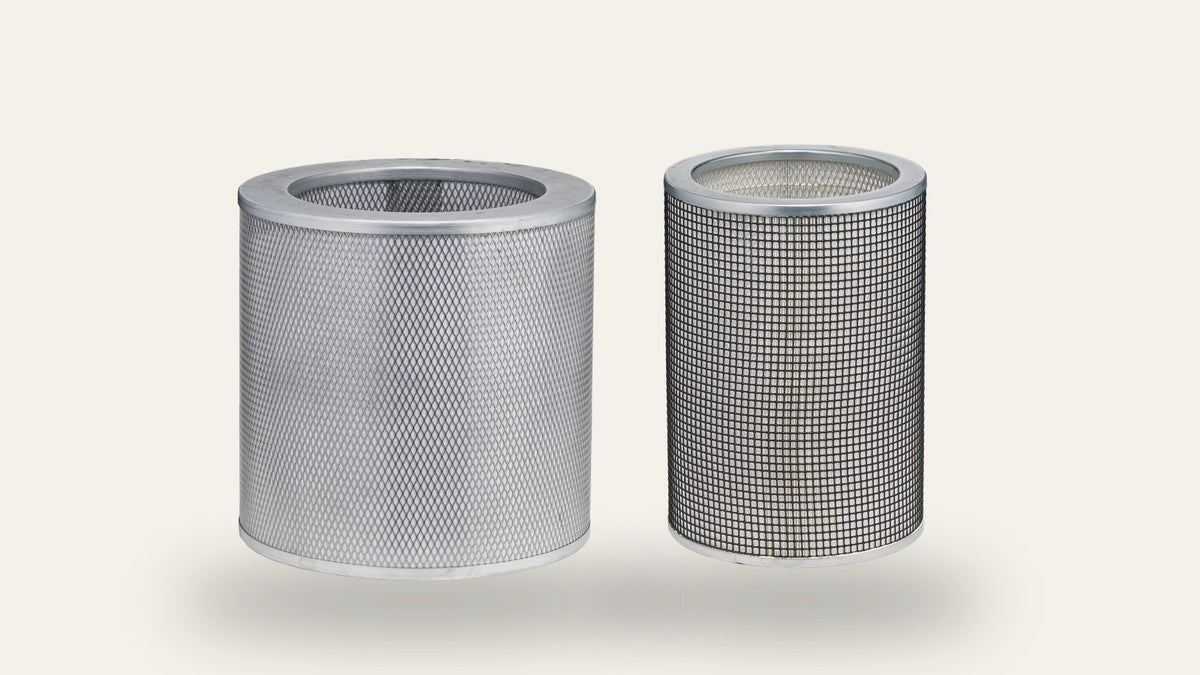
Activated carbon is carbon processed to be riddled with microscopic pores, which gives it an enormous internal surface area for its weight. VOC molecules passing through stick to those surfaces, a process called adsorption. Two practical consequences follow. First, capacity scales with weight: a thin carbon-dusted pad saturates in weeks, while a 26-pound bed keeps adsorbing for about two years. Second, saturation is invisible: a spent carbon bed looks identical and simply stops working, which is why replacement schedules matter more for carbon than for any other filter type.
Which unit for which chemical problem?
Airpura varies the carbon blend by series letter. Prices as of September 2026; the product page is the source of truth.
| Situation | Series | Carbon approach | From |
|---|---|---|---|
| General chemical sensitivity, broad VOCs | C series | 26 pounds of carbon, the deepest general-purpose bed | $1,049.98 |
| Heaviest gas loads, strongest coverage | S series | SuperGas blend formulated for the hardest chemical jobs | $1,049.98 |
| New build, renovation, pressed-wood furniture | F series | Carbon blend targeted specifically at formaldehyde | $1,049.98 |
| One known chemical exposure | V series | Blend for named specific chemicals | $999.98 |
| Chemicals as one concern among several | R series | Balanced HEPA plus real carbon, the all-purpose answer | $849.98 |
Source control still comes first
Filtration is the second move; the first is not filling the box with emitters. Let new furniture off-gas somewhere ventilated when you can, choose low-VOC paint for the next repaint, store solvents and gas cans outside living space, and ventilate hard during and after any renovation. A purifier then handles what remains, which in a normal home is plenty.
Frequently asked questions
Do air purifiers really remove VOCs?
Units with a substantial activated carbon bed do; units without one do not, whatever the box art implies. Carbon weight is the honest spec, and it is the one thin consumer units omit.
How do I know if my air problem is VOCs or particles?
Smells, new furniture, fresh paint, and renovation point to VOCs. Visible dust, pollen response, and dander point to particles. Most homes have both, which is why the units above pair carbon with true HEPA.
How long does new furniture off-gas?
Heaviest in the first weeks, tapering over months, with some pressed-wood products emitting formaldehyde at low levels for years. That long tail is the argument for continuous filtration rather than a two-week rental mindset.
How often does the carbon need replacing?
Roughly every two years on the Airpura platform under normal duty, sooner under heavy load. Replacement beds run $250 to $360 depending on series, listed openly in the filters collection.
Does carbon filtration produce ozone?
No. Adsorption is passive and mechanical. It is the opposite approach to ozone generators, which add a reactive gas to the air rather than pulling gases out.
Can I use HSA or FSA funds?
Air purification is among the categories that can qualify with a Letter of Medical Necessity, decided per order by an independent licensed provider through Truemed at checkout. The HSA and FSA page covers the flow.
The short version
VOCs are a gas problem, gas problems need carbon, and carbon is measured in pounds, not marketing. Control the sources you can, then run a sealed unit whose carbon bed matches your load: C series for breadth, S series for the heaviest jobs, F series for formaldehyde. Free US shipping and the Price Beat guarantee on the whole collection.